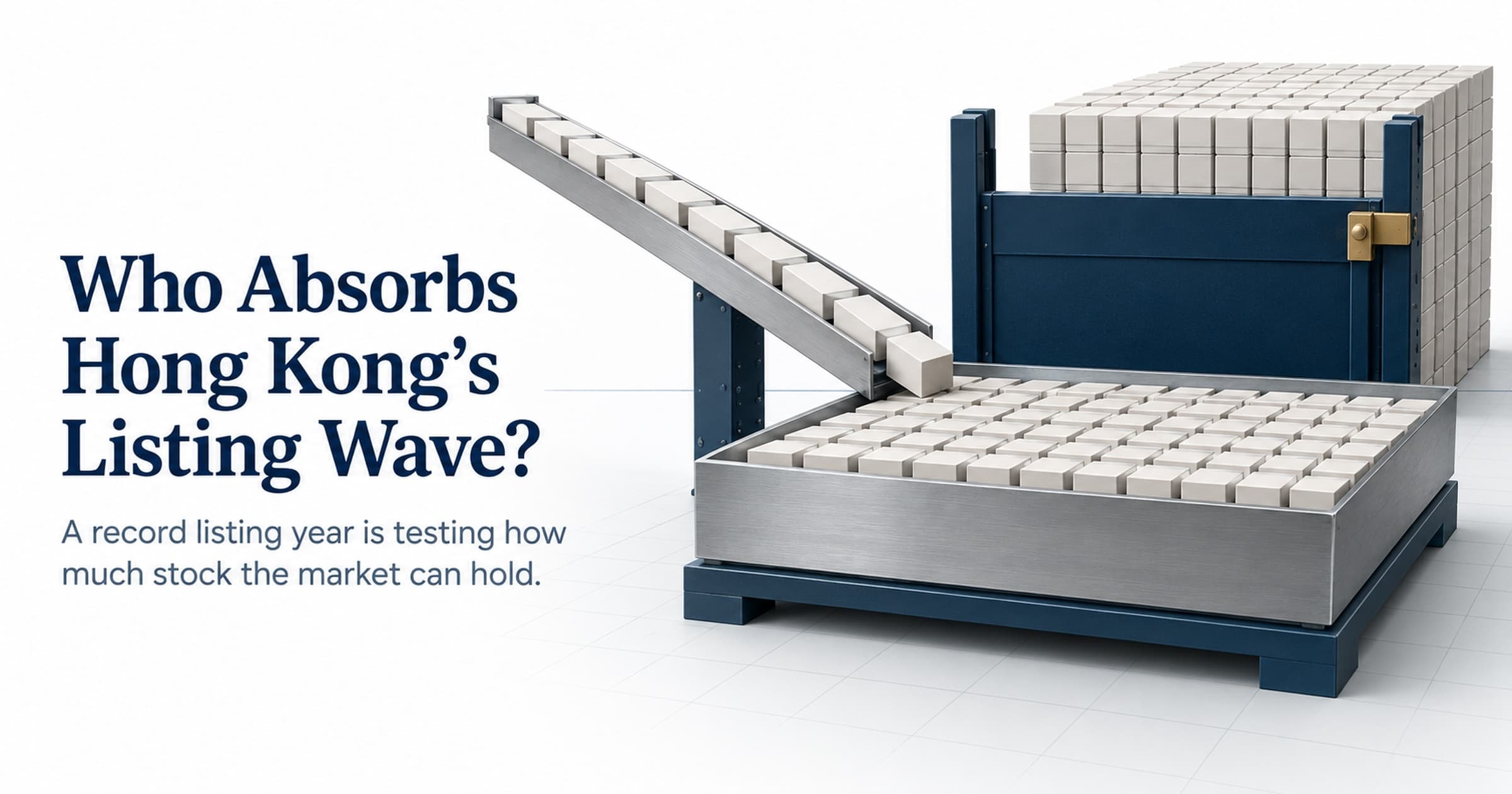
Hong Kong is having a record year for new listings. In the first three quarters of 2026, 116 listings raised more than HK$388.0 billion, according to KPMG, more than any previous nine-month total in the market's history.1
Prices moved the other way. The Hang Seng Index fell 10.7% in the first half of 2026, while the Shenzhen Composite rose 12.2%.2
A listing boom measures how much stock companies can sell. Who holds that stock after trading begins, and at what price, is a separate test.
A+H listings drive the new supply
Most IPO proceeds now come from mainland companies that already trade in Shanghai or Shenzhen. KPMG counts 38 A+H listings in the first three quarters, contributing nearly 70% of Hong Kong IPO proceeds.1 EY reports that eight of the ten largest IPOs in the first half were A+H secondary listings.3
IPOs are only part of the supply. The SFC reports HK$208.8 billion raised through Main Board IPOs in the first half, plus HK$121.7 billion through placements and rights issues.2 Listed and newly listed companies raised more than HK$330 billion of equity in six months.
KPMG counts more than 600 active IPO applicants and says full-year proceeds could approach HK$500 billion if the pipeline converts as expected.1
Southbound money is the steady buyer
Mainland investors who buy through Southbound Stock Connect are the most consistent source of demand. The SFC reports HK$301 billion of southbound net buying in the first half, and 34 consecutive months of net buying from July 2023 to April 2026, the longest streak on record.2 In March 2026, southbound investors bought a net HK$61.4 billion while the Hang Seng Index fell 6.9%.2
That buying was of a similar size to the equity raised in the same half-year. It does not follow that southbound money bought the new shares. The SFC notes that the ten stocks with the largest southbound net buying since the programme began are all large-cap index members, and they account for about one-third of the total.2 It also notes that many recent semiconductor and AI listings are too small to be index constituents, or carry minimal index weight.2
Southbound's share of trading has also narrowed. Its average daily turnover was HK$123.1 billion in the first half, or 21.8% of market turnover. In 2025, the figures were HK$121.1 billion and 24.2%.2
Total market turnover rose 13% over the same period, to HK$283.0 billion a day. The SFC attributes about half of that increase to market makers and southbound investors together.2 Southbound money still grew in absolute terms, but it did not keep pace with the market around it.
Unlocked shares are the second wave
New listings bring later supply as well. Cornerstone investors and pre-IPO holders usually accept lock-ups after a listing, and each expiry lets more stock trade.
Goldman Sachs estimated in July that a record US$274 billion of locked-up shares would be released over the following 12 months, Reuters reported.4 Goldman analysts said prices have historically dipped 4% to 7% within 3 to 6 months of a release.4 EY projects about HK$1 trillion of lock-up expiries in 2026, with July, September and December accounting for more than half.3
Individual expiries can be large. Reuters reported that MiniMax faced an expiry covering 45% of its outstanding shares in the week of 6 July.4 Holders can sell after an expiry, but they are not required to.
H-shares have cheapened against A-shares
The Hang Seng Stock Connect China AH Premium Index measures how much the A-shares of dual-listed companies trade above their H-shares.5 It stood at 127.02 on the morning of 13 October 2026.5 That was near the top of its 52-week range of 113.56 to 127.56, and 7.28% higher than a year earlier.6
A higher reading means the same companies cost relatively more in Shanghai and Shenzhen than in Hong Kong. The index does not show why. The SFC links Hong Kong's first-half weakness to an index with little semiconductor exposure, worries about higher US rates, weak consumption and profit-taking in technology stocks, not to listing supply.2 Supply is one plausible pressure among several.
The case for a broader buyer base
The strongest objection is that southbound money is not the only buyer. EY reports that 85% of Hong Kong IPOs in the first half of 2026 included cornerstone investors, among them sovereign wealth funds from the Middle East and Singapore.3 It describes international allocation appetite as recovering.3
EY also argues that the lock-up wave is less threatening than its size suggests. In its view, most of the shares belong to controlling shareholders, local governments, state-owned platforms and strategic investors with no near-term reason to sell.3
The cornerstone rate was almost unchanged from 86% a year earlier, and EY advises companies on listings.3 Cornerstone commitments also show demand at the offer, not after the lock-up ends.
Four signals for the next quarter
Southbound flows come first: if net buying continues and its share of turnover recovers, the steadiest buyer is growing with the market again. Trading after the September expiries, and into the December ones, will show how many unlocked holders choose to sell. A narrower AH premium would suggest that H-shares are absorbing the new A+H supply; a wider one would suggest they are not. In new deals, international cornerstone commitments would show demand beyond mainland buyers, at least at the offer price.
Footnotes
-
KPMG China, Hong Kong IPO fundraising could reach HK$500 billion in 2026 ↩ 2 3
-
Securities and Futures Commission, Research Paper No. 79: Half-yearly Review of the Global and Local Securities Markets ↩ 2 3 4 5 6 7 8 9
-
EY, Chinese mainland and Hong Kong IPO report, June 2026 ↩ 2 3 4 5 6
-
Reuters, Record wave of IPO lock-up shares to hit Hong Kong market ↩ 2 3
-
Hang Seng Indexes, Hang Seng Stock Connect China AH Premium Index ↩ 2
-
Financial Times, Hang Seng Stock Connect China AH Premium Index ↩